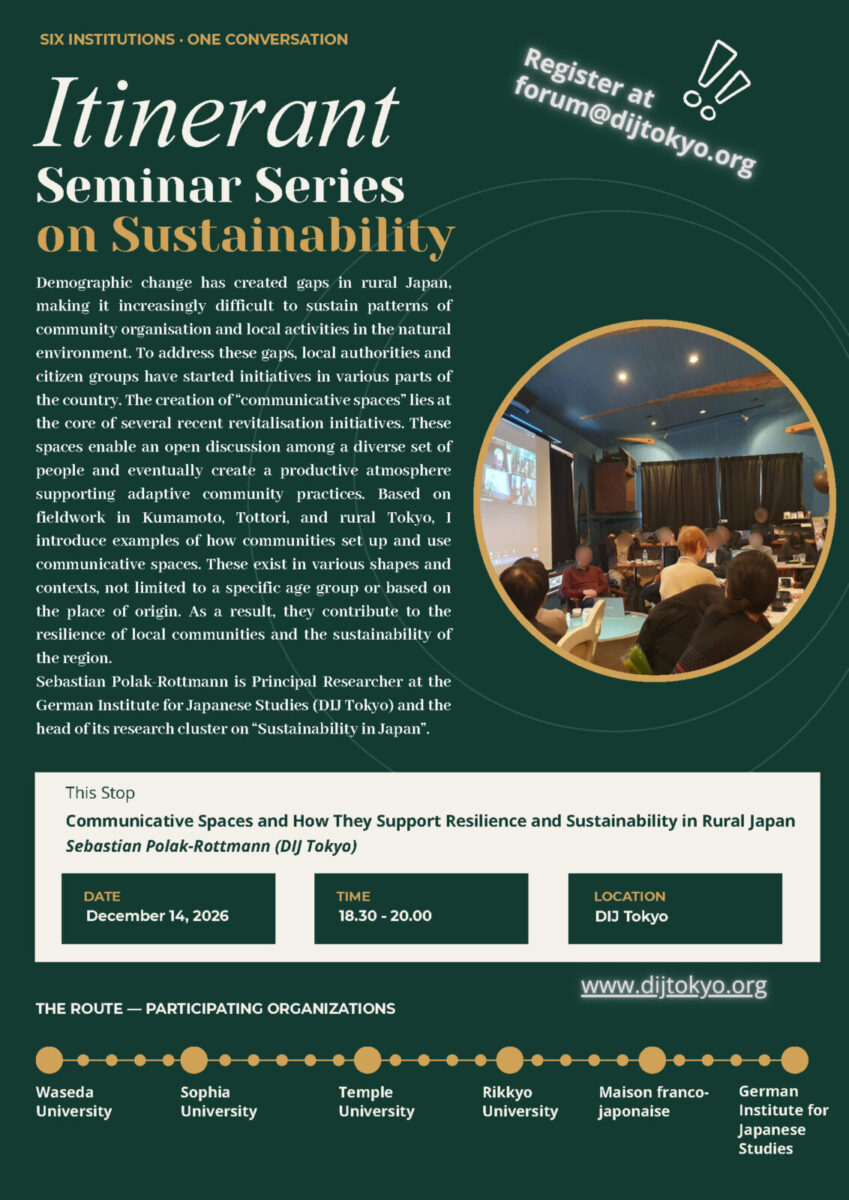
Short poster version Communicative Spaces and How They Support Resilience and Sustainability in Rural Japan
[館外イベント] Sebastian Polak-Rottmann (DIJ Tokyo)
18:30~20:00 DIJ Tokyo 英語 通訳なし
Register at forum@dijtokyo.org !
Demographic change has created gaps in rural Japan, making it increasingly difficult to sustain patterns of community organisation and local activities in the natural environment. To address these gaps, local authorities and citizen groups alike have started initiatives in various parts of the country that implement different models to cope with the current situation. This paper understands the creation of a “communicative space” (Okada 2021) as the core of several recent revitalisation initiatives. These spaces enable an open discussion among a diverse set of people and eventually create a productive atmosphere supporting adaptive community practices.
Based on my fieldwork in three regions in Japan (Kumamoto, Tottori, rural Tokyo) I introduce three different examples of how communities set up and use communicative spaces. I demonstrate that these spaces are not limited to a specific age group, such as older adults, or based on the place of origin, such as some community associations, but exist in various shapes and contexts. As a result, they contribute to the resilience of local communities and the sustainability of the region.
Sebastian Polak-Rottmann is principal researcher at the German Institute for Japanese Studies (DIJ Tokyo) and the head of its research cluster on “Sustainability in Japan”. His research focuses on spatial aspects of the resilience of local communities in Japan. He received his PhD in 2022 (University of Vienna, Department of East Asian Studies) on the well-being and political participation in the Aso region in Southern Japan.